With the advancements in audience targeting and real-time bidding, display advertising is continuing to grow in its efficiency. Forrester projects that by 2016, the percentage of advertising dollars spent on the display network will make up 36% of all interactive media – shy only 8% of the total advertising spend for search, which is set to slide down to 44% (search currently claims a 55% share today).
One of the factors Forrester attributes to search’s decreasing pace of growth (albeit still growing) is that search advertisers are having trouble keeping up with keyword costs. Search undeniably has its advantages over display when it comes to direct response, but since people are recorded to spend only 5% of their time on the web on search engines, advertisers need reach prospective consumers in other channels.
I’d like to give readers of this blog some insight into how I approach display advertisements on a strategic level – something I’ll demonstrate by creating a fictional campaign. Although I usually stick closely with the mind-set of allowing data to speak, there are numerous amount of other factors that need to be evaluated for correct branding purposes – factors that won’t reflect in mere metrics (at least in the short term). Therefore, this write-up may seem very stream of thought, but they all have elements that will ultimately influence the decisions advertisers should make in preparation of a campaign launch. Additionally, as I believe many circumstances warrant a combination of both display & direct platforms for advertisements, I will follow up with this post with a part II of when display advertisers should take that next step to negotiate directly with publishers.

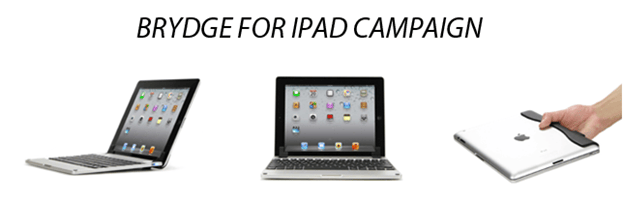
I recently became aware of a KickStarter Project that called the Brydge that is set to release an innovative product for the new iPad. The Brydge is an iPad keyboard case crafted entirely out of anodized aluminum with built-in speakers. I’ve seen quite a bit of keyboard cases before, but none as appealing as this particular product. So for the purposes of this write-up, I’m going to put on a Brydge cap as I create a fictional digital advertising campaign for their keyboard case with a monthly spend of $10,000.
Web Research
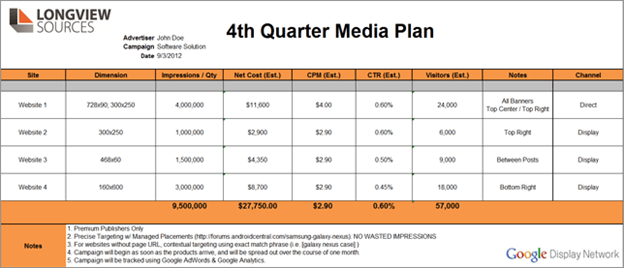
Based on an estimated average CPM of $3.00, I’m anticipating my budget will generate anywhere from 2M-4M monthly impressions. Some websites will require significantly higher CPMs (while some will warrant significantly lower CPMs), depending on how many competitors are bidding to place on the same site; but $3.00 CPM is a good starting point. With this relatively small budget, it’s important to reach a very select audience that will maximize every penny of my advertising spend.
My most ideal audience is the early adopters within the iOS community who would more likely serve as evangelists of the products they purchase than the average owner of an iPad. Furthermore, since the Brydge is a specialized product not really geared for the average iOS user, it becomes critical to grab hold of a highly enthusiastic iOS consumer base. Therefore, I need to begin my research to hand-select a group of websites that attracts these types of consumers.
Sites
Through some research on Google’s search engine, I came up with 3 websites running AdSense that seemingly fit my criteria (you may also use the placement tool for this research). Under an actual campaign, I’ll usually have about 15-20 potential websites to target, so the list above is by no means a complete list, nor do those websites reflect the most ideal websites for this campaign. The websites I selected all have strengths and weaknesses in respect to the Brydge campaign, and they were chosen because they all feature some distinct attributes that will make or break my decision to target them. Thus, they create good examples for the purposes of this write-up. With that said, these websites were chosen for consideration for the following reasons:

1) The specificity of the site’s content
I need to get as close to a pure iOS consumer base as possible. I’m not going to target a website that revolves around broad topics like technology, nor do I want to target a website that revolves around general mobile devices, e.g. PhoneArena. I want to get the purest concentration of iOS enthusiasts, and the websites I listed seem to fit that bill.
2) True influence within the iOS community
I can make a good assessment about who the real influencers are with the following information:
- Monthly Unique Visitors & Monthly Unique Page Views – This can be found through websites that calculate traffic, e.g. Quantcast, Compete, Alexa. This information may also be available through the publisher’s advertisement page and/or their advertising partners, e.g. BuyAds, Federated Media, BuySellAds, etc.
- The level of engagement within their community – Community interactivity based on the participation within the website’s forums and comment section, along with their various social media channels.
- Backlinks – Researching which publishers are linking to their website – Sites like Open Site Explorer and BackLinkWatch will list many of the publisher’s backlinks (it’s necessary to confirm these links by visiting the pages (the URL of the pages that link to the particular publisher being researched will be listed in the sites mentioned) to ensure the links are coming from the writers and not from the comment section.
- Website history – Confirming how long the website has been around for.
Learning which websites will deliver the best results for both branding and direct response can take some time to discover. One quick reminder – brand equity is built (for better or for worse) through banner ads. So no matter how much traffic a website may receive, never target a website that might reflect negatively on your client’s brand, no matter how low the CPM is, and no matter how strategic from an immediate ROI perspective a well-placed banner on that website can perform. One of the more obvious examples in this particular campaign would be a website like AppleBitch (All Apple, All Day), with their domain name giving me enough reason to take it out of consideration (also another reason why I typically don’t allow Google to take the wheel as a result of using automatic placements).
3) Site Content – Going beyond the website’s self-description
I scan through the site’s content to see what really drives their traffic. Although a website may generate a lot of traffic, the quality of every impression is NOT equal. For example, there are plenty of content farms out there that don’t generate the level of quality impressions that a specialized blog would. These content farms may have large chunks of information about Apple, but this does not mean that the sites are run by true influencers. Associating my client’s brand with these particular websites will trigger very lukewarm results from a branding perspective. So in this case, the 3 websites I listed all revolve around original, specialized content from serious influencers that seeks to enhance the iOS experience; either that, or they host a very interactive forum for an enthusiastic iOS community – more on this later.
4) Banner Dimensions and Location
I note all ad dimensions in these potential websites to figure out the ad formats for my designer. After I scan through some of the different categories within the website (as the banner layout can change from page to page, e.g. subdomains), I’ll begin to jot where the ad units are located. The difference between targeting a poorly placed banner as opposed to targeting a strategically placed banner will make or break any campaign.
5) Number of advertisements (what’s the share of voice?)
I noticed a lot of publishers who have great potential significantly lowering the user experience of their website as a result of too many advertisements. Some of these publishers make the strangest choice for their ad layouts. I’ve seen one particular publisher who had about 16 ad units on their sidebar alone, splattering rectangles, buttons, and skyscrapers in a dizzying array of distractive advertisements. Even worse is that all those ad units are occupied by very low quality companies. To top it all off, the actual content was infiltrated with annoying Kontera in-text ads. With the miniscule share of voice with each impression, agitating reader experience and the prospect of coupling the Brydge alongside those disreputable companies make for a highly unattractive site to target.
Instead, I want my client’s brand to be associated with publishers who show a measure of discernment in who they allow themselves to be associated with. That ensures advertisers will be placed in good company. Also, more exclusivity (minimum ad units to promote a classier website alongside a better reader experience) will cure some of the banner blindness while creating more positive associations with my client’s brand.
Site Analysis
MacRumors
MacRumors attracts users of all Apple devices (as opposed to a solitary iPad user audience base). Targeting the general homepage URL and allowing the banners to spread throughout the site’s entirety is a sure-fire way to waste hundreds of thousands of impressions. Separately, I’d rather not rely on Google’s technology to place the banners according to the theme of my keywords as this is a level of control I don’t want relinquish to Google. I’ve found their algorithm for matching keywords with the correct synonyms and body of content still needs too much work.
So after about ten minutes of navigating through MacRumors, I’m deciding there are two subdomains that might serve our Brydge campaign very well – one of which can potentially generate an excellent return from a direct-response basis.
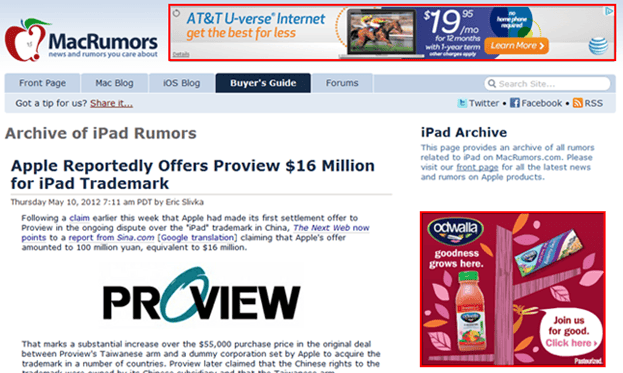
The first subdomain would be MacRumor’s iPad category (ipad.macrumors.com), which is the URL I’ll copy and paste to my managed placements.

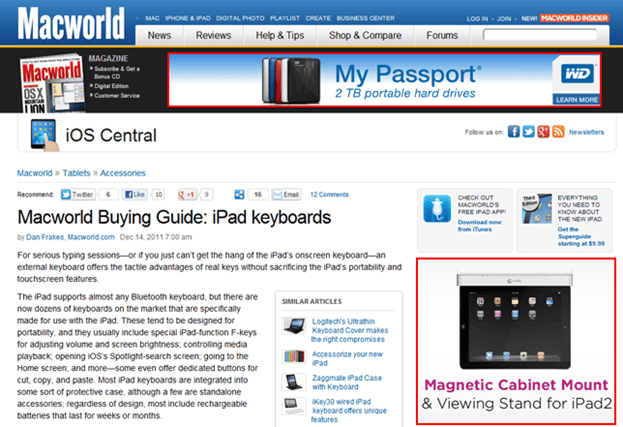
MacRumors (excluding their forum) has just two ad units ATF (728×90 – top center, 300×250 – top right) within their pages. I’m attracted to the exclusivity of their banners because those two units encompass their entire advertising estate, giving me 100% share of voice with each impression (or 50% if another advertiser’s banner occupies one of the slots). Furthermore, their ATF banner position ensures that all users will see the banners, and I won’t have to worry about a competitor out-bidding me and sending my banner into a free-fall into a slot BTF.
However, really digging deep into the iPad category, I notice that most of MacRumor’s content revolves around news pertaining to Apple as an industry, with little to no content that aims to enhance the iOS experience for a strict consumer base. This makes me wonder if their audience is for the most parts made up of industry folks – people who are Apple shareholders or businessmen just fascinated by Apple as a company, trying to figure out their next move. However, there’s no doubt in my mind that it would be testing 250,000 impressions to find out if this website will generate good returns from a direct-response basis, even though I think it’s questionable if it would be the correct website to target for brand-building purposes. I say this because the authors seem to be recognized for being one of the forefront publishers to break industry news as opposed to being an expert of the actual iPad device and the apps and accessories that come along with it.
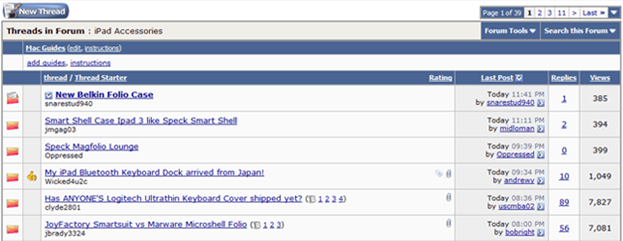
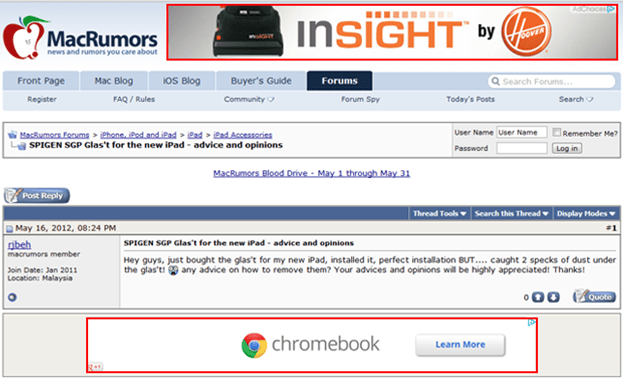
MacRumors forum has a vibrant & highly engaged community. With various topics for community discussions, I’m delighted to see that one of their more popular categories happen to be “iPad Accessories.”

Checking a string of threads within the “iPad Accessories” category, I notice a leaderboards is always placed at top center, with 1-2 other leaderboards tucked in between some of the posts. I’d prefer that my banners are locked at top center every time, but from a direct-response perspective, and in particular with this forum, it shouldn’t matter as much if competitors were to outbid me for that top spot from time-to-time. I say this because I’m assuming if a user is visiting a forum for iPad accessories, that user is highly engaged with every word that’s written in the threads she chooses to visit. So even with studies that show that banners ATF will generally increase CTR by 36%, I believe that the divide in CTR with ads ATF & BTF will be much narrower. Separately, it may very well be the case that prospective buyers who visit my website from a forum may be more valuable than a prospective buyer who visits my website from search engine ad. Additionally, although I don’t know how users would navigate through this forum, but I would imagine that the first course of action for many members would be to click a blank space, and scroll down just a bit so that they can a larger block of content at once, having the original post hovering at the top of their screen with the leaderboard at top center not visible.

Furthermore, as it’s very convenient for logged-in members of the MacRumors community to create some buzz around the innovative Brydge as my campaign enters into the crux of the iOS groundswell, I’m hoping that the force behind word-of-mouth can be on par (hopefully even greater) with my display advertising campaign.
One of the more unfortunate aspects of MacRumor’s subdomain for its forum – forums.macrumors.com – is that I cannot target a certain page as their pages are all dynamically generated. So what I need to do is insert display keywords that relate to the Brydge, crossing my fingers that Google locates the most relevant slots to place my banners. And even though I’m assuming a select iOS audience will be visiting this forum, I can narrow down even further by ensuring only tablets using an iOS operating system can view my banners (mobile users, according to Quantcast, accounts for 20% of MacRumor’s traffic). I can always adjust this in my campaign settings if my banners aren’t generating enough impressions.
One additional piece of information I noted from Quantcast is MacRumor’s monthly page views, which is hovering slightly above 60,500,000. I’m taking a guess here, but I would say that 60-70% of all banners on their page are through an ad exchange (remnant inventory). Based on the amount of remnant inventory I see on MacRumors, I’m going to start my bids really low at $2.00 CPM. I’m estimating that I can generate 500,000 – 1,000,000 impressions with this bid in a month without much trouble. If upon launch I find out this is not the case, I’ll need to increase my bid.
MacWorld
MacWorld intrigues me quite a bit. Not only do they have a website that I know generates quite a bit of traffic, but I know MacWorld’s magazine is in the bookstores and newsstands across the country. So MacWorld is definitely one of the biggest voices in the iOS industry, as they have been since 1984. I don’t have any doubt in my mind that I want my client’s brand to be associated with this website.
However, upon going through fifteen or so pages, it appears that there isn’t much remnant inventory available, so I do wonder if I’ll be able to generate any meaningful impressions through the display network. Another aspect of MacWorld that concerns me is that the website appears very scatter-brained, with plenty of news, reviews, and how-to that has nothing to do with Apple. Not only do I think this may turn off some of their readers, but it also makes it difficult to have any sort of assurance that I’ll be generating relevant impressions every time.
Since content is not structured into clearly separate categories, one way I’ll attempt to generate the best impressions is to target related pages within MacWorld. By looking at MacWorld’s Alexa rank, I know they’re going to rank high in the search engines for various keywords. In fact, by searching “iPad Case Review,” I see 3 pages from MacWorld ranking within the top 5 results.

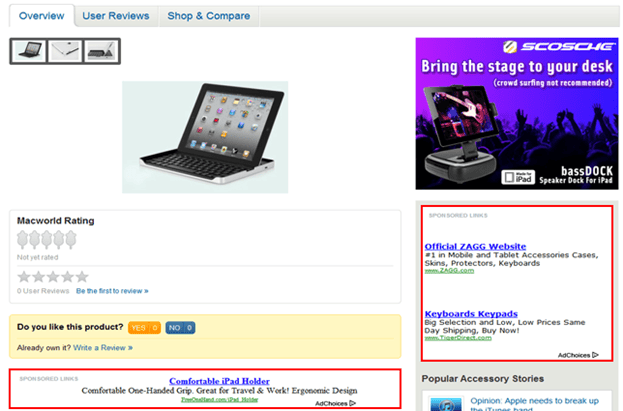
Like MacRumors, MacWorld has just two ad units ATF (728×90 top center, 300×250 top right) for image ads. MacWorld has two text ad units towards the bottom of the page, but I don’t need to worry about my banners being cast down there as those slots never serve image ads. Based on the rarity of the remnant inventory alongside the value in associating the Brydge with MacWorld, I’m going to bid 4X the amount I bid for MacRumors (I’ve rarely seen any bids that generated impressions reaching anywhere near the maximum CPM), but nonetheless, I will closely monitor the performance of these placements when my campaign goes live.

I’m intrigued by MacWorld’s text ads, which are placed on the bottom right and bottom center of the page. In a separate campaign, I will switch my bidding model to CPC (max bid at $0.51) and insert the display keywords. I will then create a very compelling ad copy and target MacWorld’s tablet section – www. macworld.com/products/tablets.html .
The text ads will be strictly measured from a direct-response perspective, so throughout the course of testing, if my CPA is not justifying the cost for this ad group, then I will discontinue with the text ads. But before I make a decision to pause this particular text campaign, I’m aware there are plenty of opportunities to create strategies with smart placements, so there needs to be a continuous series of thoughtful adjustments.
MacLife
MacLife is another intriguing publisher who can potentially be valuable for both branding and direct response. Alongside their online presence, MacLife has a presence offline as the second largest Apple magazine after MacWorld. Furthermore, a combination of their online traffic along with the number of other high-tech publishers referencing them gives me the impression that they’re an authoritative voice amongst iOS users.
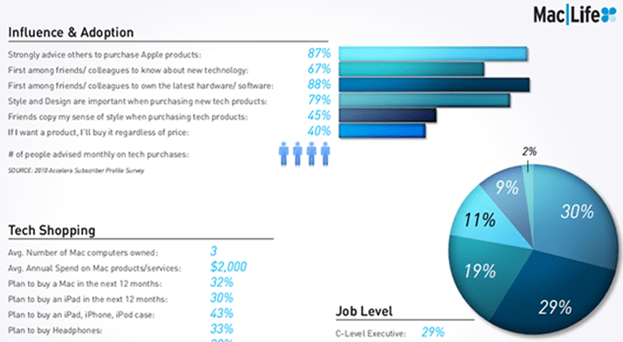
One additional luxury is MacLife’s advertising page, where MacLife provides a comprehensive media kit for prospective advertisers.

I don’t know how accurate the numbers on these surveys are, but I’ll take whatever information I can get. According to the surveys, it seems MacLife’s demographics fit my target audience pretty well. 88% of the participants in the survey claim to be early adopters while serving as evangelists of their latest and greatest Apple gear, with the average user claiming to spend $2,000 for all things Mac.

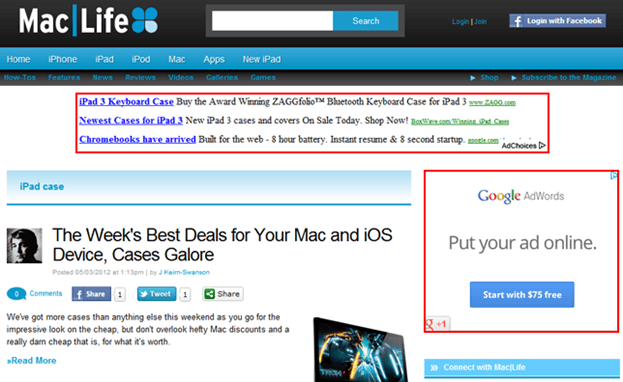
MacLife has three ad units ATF (728×90 top center, 300×250 top& bottom right). Also, their categories are neatly organized, with two categories just for iPad accessories – www.maclife.com/tags/ipad_case & www.maclife.com/tags/ipad_accessories. I’ll copy and paste both URLs onto my managed placements.
Since there’s no other leaderboard except the one locked at top center, I can start my bid for my placement at around $3.00 CPM, making the necessary adjustments as the campaign runs its course. On the other hand, there’s a big difference in being ranked for slot 1 as opposed to slot 2. So I’ll either start my bid for the 300×250 ad unit a lot higher at $6.00 CPM, or I might consider switching to a CPC model. That way, I won’t have to worry about my 300×250 ad unit generating impressions but not being viewed.
Optimization
With the information I just presented, I hope advertisers launch campaigns with endeavors in both brand-building and direct-response. Advertiser need to determine the value of each and every website they choose to target. This freedom should be infuriating for publishers because this essentially states that publishers running ad networks have little control in dictating how much their content is worth – this is a luxury display advertisers can and should seize.
Claude Hopkins once said “There is always a way to get the same results at a fraction of the cost.” To provide an example, I mentioned that my monthly budget is $10,000, which I estimated might generate 2M-4M impressions. If I wanted, I can use up all these impressions targeting my site list in a few days. However, this would mean that I would need to bid very high to secure the publishers’ level of daily page views – in the case for MacRumors, there’s a huge difference in the level of competition in bidding for 2M daily impressions as opposed to bidding for 60M monthly impressions. Therefore, if I spread out the number of impressions for MacRumors over the course of a month, the difference in CPM can potentially generate hundreds of thousands, if not millions of more impressions.
If display advertisers set a daily cap for the number of impressions for each website (taking the number of monthly impressions and dividing by 30), they can save a lot of money. Like a heavily rocking pendulum, the CPMs for all websites can swing to both extremes in price depending on the level of competition.
Final Word
This blog post was written to demonstrate that all display advertisers who follow these steps of research, site analysis, and optimization decisions can create effective display campaigns.
Additionally, this write-up is partly inspired from my experiences on the client-side – a period when I dealt with quite a few ad agencies and sales reps. But something I found so frustrating within the course of these discussions would be that within the first ten minutes of conversation, many of these agencies and sales reps would hastily propose a solution to solve complex challenges – as if they really understood everything there is to know about my industry. Then, either because of these agencies’ laziness or their attributing the smallest level of value to my status as their prospective client, they would email me with an attachment of some vanilla proposal that would really insult my intelligence.
This is a problem I encounter too frequently in this industry. The end-goal for so many digital advertising agencies appear to be to complete the bare minimal with as little effort as possible, as many clients understandably cannot detect many of the shortcuts these advertising agencies takes. I’ve seen this lack of effort and/or attention take form in advertisements showing up in irrelevant websites, banners dangling in no man’s land, and creatives that fail to command high-impact impressions that really drive brands.
As I hope my article demonstrated, every campaign should require a substantial degree of thought and preparation; these are all very necessary steps to fulfilling your promise to the client and the validation of whatever title you claim. And with this comes exploring direct advertisements as the next best course of action if you determine it to be so, which is the topic I’ll follow up with.
Delbert Kim is an internet marketing consultant at Longview Sources specializing in search & display advertisements and is passionate about helping small businesses understand and develop intelligent internet marketing campaigns. You can connect with him on LinkedIn.
Opinions expressed in the article are those of the guest author and not necessarily bgTheory. If you would like to write for Certified Knowledge, please let us know.